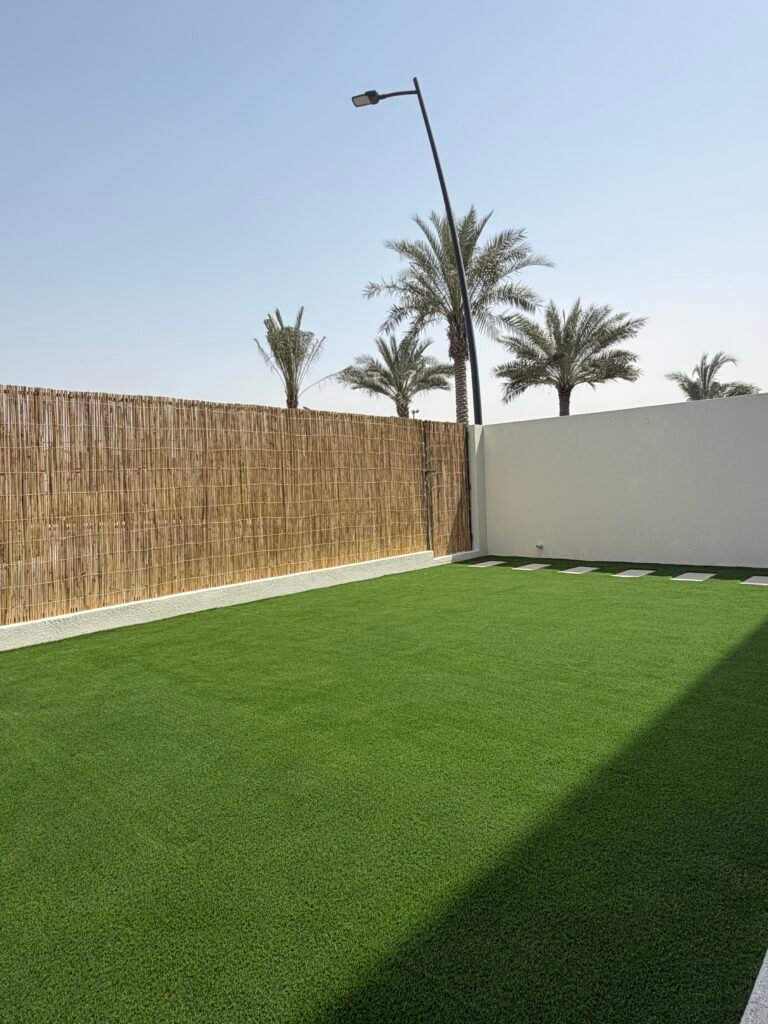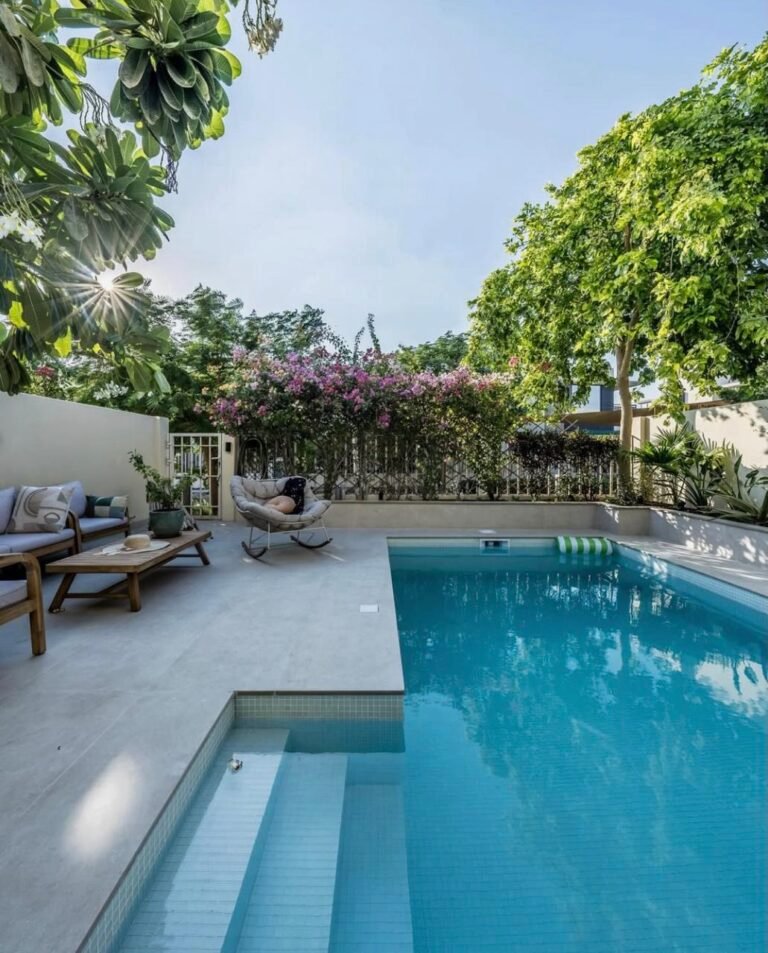

Get the shade right and a Dubai villa garden works eight months a year.
Most villa gardens here fail on one thing. There is nowhere shaded to sit, so nobody goes out.
Landscape design Dubai villa owners commission in August has one deadline behind it: October. That is when the garden becomes usable again, so the drawings, approvals and ordering all happen while the plot is still too hot to sit in.
Good planting will not fix that. We draw the covered zone first, then set the terrace, lawn and beds against it.
The short version
- Shade is drawn before anything else on the plan.
- A pergola or louvred roof adds the shoulder months at both ends of the season.
- Irrigation, drainage and power go in before the paving.
- Planting is chosen for the shade it will grow into.
On this page
- The quick answer
- Why landscape design Dubai projects start with shade
- How we design a villa garden, step by step
- Comparing shade: pergolas, louvres, sails and trees
- Irrigation and drainage come before the paving
- Design choices that still look right in ten years
- Planning the design with the rest of the garden
- Choosing a landscaping company in Dubai
- Frequently asked questions
- Areas we cover
- Book your free site visit
The Quick Answer
Start with shade, then services, then surfaces, then planting. Put the irrigation and drainage in before a single slab is laid, and choose plants for the conditions they will actually live in.
That order matters more than the plant list. The landscape design Dubai homeowners are still happy with ten years on is usually the one that was drawn in the right sequence.
Why Landscape Design Dubai Projects Now Start With Shade
For years the standard villa garden here was laid out the same way: lawn, border, a few palms, and furniture on an open terrace. It looks good in January and sits empty from April onwards.
That has changed. The landscape design Dubai villa owners ask us for now starts with a shaded structure, because shade decides whether the garden gets used at all. Get a covered zone right, with air moving through it, and the rest of the garden follows.
Signs a garden was laid out in the wrong order
That is a layout problem rather than a planting one, and it is fixable. Sorting it on a drawing in August is a great deal easier than sorting it in concrete in November.
Timing follows the season. A villa garden here is comfortable from October to May, and nobody wants skips and scaffolding in it during those months. Working through the hottest weeks is no fun for anyone, but it is how you get eight useful months out of a garden instead of six.
Shade also decides a lot of the detail. Paving in full sun wants a different finish from paving under a canopy, and planting under a louvred roof behaves nothing like planting three metres out from it. So a scheme that can actually be built settles the covered zone first and works outwards.
How We Design a Villa Garden, Step by Step
Every project we take on runs in the same order. There is nothing clever about it, but it is what stops changes turning up halfway through a build. You can see the same process set out on our process page.
Eight stages sounds like a lot. In practice the first three do most of the work, because that is where a landscape design Dubai clients live with for years is either got right or got wrong.
Site visit and brief
We walk the plot with you, note where the sun sits through the day, and listen to how the family actually lives outdoors. Most briefs change once we are standing in it.
Survey and levels
We measure the plot, pick up existing levels, and find the boundaries, service runs and any fall towards the villa. Accurate levels keep water away from the house later.
Concept layout
Next comes the layout drawing: where the shade sits, where you eat, where you swim, and how you move between them. We test two or three before settling on one.
Shade and structures
Pergolas, louvred roofs, screens and canopies are drawn now rather than added at the end. Their positions set the geometry of the garden.
Below ground, then above it
Services below ground
Irrigation, drainage, pool plant, lighting and power for an outdoor kitchen are routed now. Once paving goes down, changing any of it means lifting it again.
Hard landscaping
Then the terraces, steps, walls and pool surrounds go in. We choose materials for how they behave underfoot in direct sun, not how they look in a showroom.
Planting and lawn
Planting follows the structure, because by now we know where the shade falls. We match species to those pockets rather than spreading them across the plot.
Handover and aftercare
Finally we set the irrigation controller, walk you through the lighting, and leave a simple care schedule. Our maintenance team can take it from there if you would rather not.
Comparing Shade: Pergolas, Louvred Roofs, Sails and Trees
There is more than one way to get shade, and each option behaves differently in heat, wind and dust. Most gardens end up using two of them rather than one.
| Option | Character | Airflow | Upkeep | Best suited to |
|---|---|---|---|---|
| Timber or aluminium pergolaMost versatile | Warm, architectural, softens a hard elevation | Good, especially with an open top | Occasional cleaning; recoating on timber | Dining terraces and seating zones next to the villa |
| Louvred roofMost control | Clean and modern, adjustable through the day | Controlled, closes against rain and dust | Low, though the mechanism needs servicing | Outdoor kitchens and year-round living rooms |
| Shade sailFastest to fit | Light and informal, quick to install | Very good | Tensioning checks; fabric replaced in time | Pool decks, play areas and larger open spans |
| Tree canopyCoolest shade | The most comfortable shade of all | Excellent | Pruning, feeding and steady irrigation | Boundaries, driveways and long-term planting schemes |
Swipe the table to compare.
Trees give the best shade of the lot, because a canopy cools the air instead of only blocking the sun. The catch is that they take years. So most landscape design Dubai schemes use a built structure for shade now and let the planting catch up behind it.
Irrigation and Drainage Come Before the Paving
Almost every garden we get called back to has the same story behind it. The surfaces went down first and the services were fitted round them. Then a line leaks or a bed dries out, and the only way in is to lift a terrace.
Dubai gardens ask a lot of an irrigation system. Sandy soils drain fast, salinity builds up, and daytime evaporation takes a large share of the water. So we zone irrigation by planting type rather than by area, and size the controller for the garden it will grow into.
Drainage matters just as much, dry climate or not. Rain here arrives all at once, and a flat terrace with nowhere to send it will push water at the villa. Falls, channels and soakaways are straightforward at design stage and a nuisance afterwards.

Not sure what is buried under your garden?
We survey the plot and pick up levels before a single line is drawn.

Design Choices That Still Look Right in Ten Years
Gardens date faster than the houses they sit against, and it is usually because too many ideas went in at once. Knowing what to leave out is most of the job.
We keep the palette short. One paving material, one timber tone, one metal finish, used everywhere. Three materials repeated across a garden looks calm. Nine looks like a showroom.
Scale is the second thing people get wrong. Terraces end up too small for the furniture, and pergolas sit too low for the space they cover. We check both against real dimensions at layout stage, before we order anything.
Two materials, one shade structure, and planting that grows into the gaps. That combination still looks right a decade later.
Reshape Landscaping and Design · Design teamMaterials have to survive the conditions here, not just suit the look. Pale porcelain stays cooler underfoot than dark stone, and powder coated aluminium holds up better than untreated steel near a pool. Those choices are unglamorous, yet they decide how the garden looks in year five.
You can see how that plays out across finished gardens on our projects page.
Recent projects
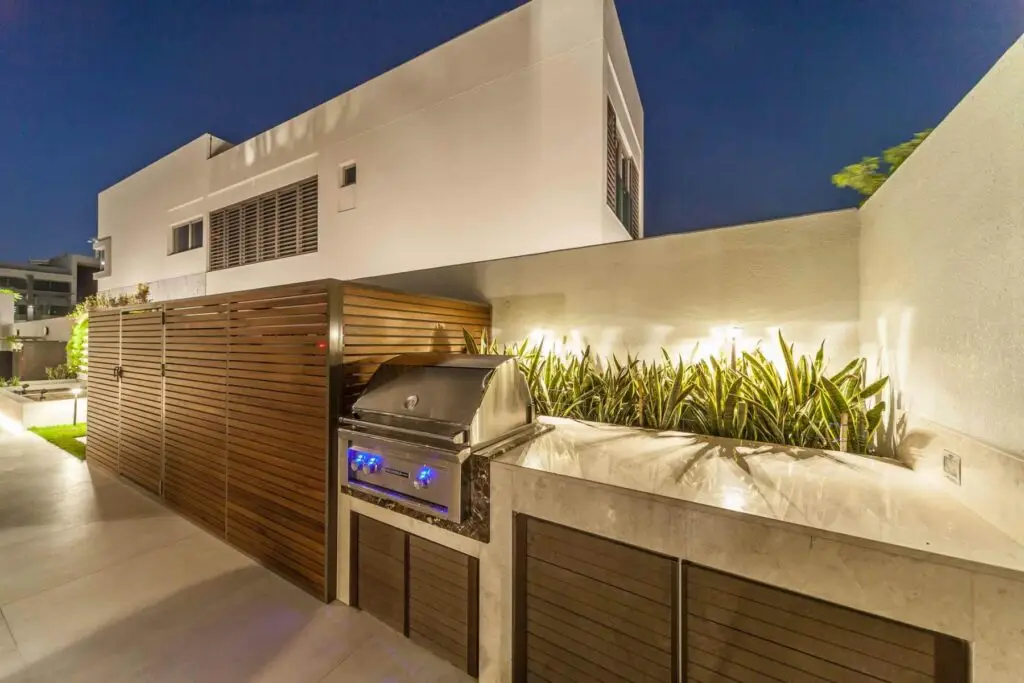
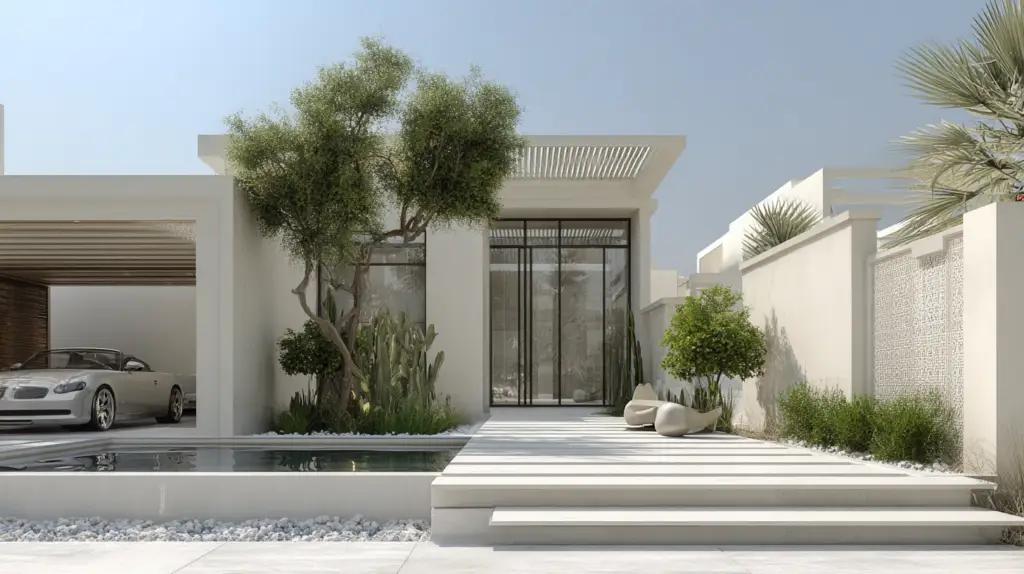
A selection of our work



Planning the Design With the Rest of the Garden
Shade rarely turns up on its own. Once a covered zone is drawn, the pool, the kitchen and the lighting all need to relate to it. Doing them together is a great deal tidier than doing them one at a time.
It also avoids the worst result, which is a garden put together in three phases by three unrelated trades. We draw and build under one roof, so the garden you approve on paper is the one that gets built.
As a landscaping company Dubai villa owners come back to, we regularly deliver landscape design alongside:
Choosing a Landscaping Company in Dubai
There is no shortage of contractors here, so the useful questions are narrow. Ask who will actually draw the garden, and whether the same company builds it. Then ask what happens to the irrigation once the site closes, and to see a garden finished three years ago rather than three months ago.
Why villa owners pick us
Established in 2010, with more than 400 completed projects and designers qualified through the National Design Academy.
- Rated Best of Houzz 2026 for service.
- British owned, and working in Dubai since 2010.
- We design and build, so nothing is lost between two companies.
- We draw to scale, so nothing gets guessed at on site.
More about the team is on our about us page.
Landscape Design Dubai: Frequently Asked Questions
Design in the summer and build through September, so the garden is ready as the season opens in October. Start in November and you lose half the good weather to the works.
Usually survey to final drawings runs a few weeks, depending on how many layouts you want to see. Build time depends on the scope, particularly whether a pool is involved.
Usually yes. Most communities need approval from the developer and the wider community authority, and pools need authority sign off. We prepare the drawings those submissions ask for.
Yes, although it needs the right species, correct irrigation zoning and some shade. Where a lawn is in full sun all day, artificial grass is often the more sensible answer.
Yes, and a good part of our work is exactly that. We keep what is worth keeping, usually mature planting and anything structurally sound, then redesign around it.
We do. Because gardens here need steady care rather than the odd visit, so most clients keep us on for irrigation checks, pruning and seasonal planting.
Areas We Cover
We take on landscape design right across Dubai, and most of our work sits in the established villa communities. Full details are on our locations page.
Book Your Free Site Visit
If you want the garden finished for October, the drawings need to start now. We will visit, measure the plot and come back with a layout you can picture. There is no charge for the visit.
Whether you are starting from a sand plot in Tilal Al Ghaf or reworking a tired garden in Arabian Ranches, the first conversation is the same. Tell us how you want to use the space and we will tell you what the plot allows. The gardens that work here start with that conversation, not with a catalogue.